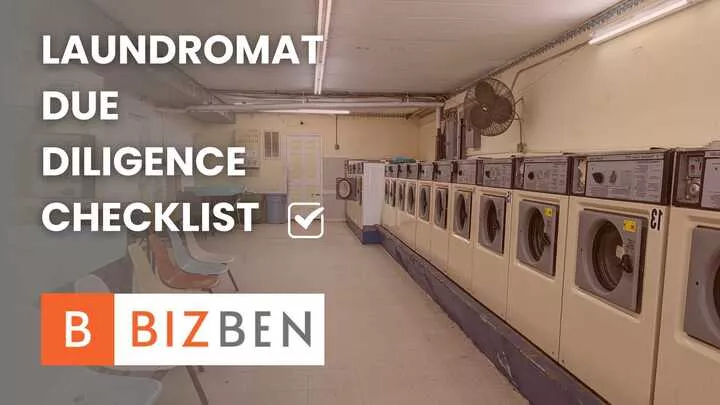
The U.S. laundromat industry, a stable and recession-resistant market valued at approximately $5.3 billion annually, offers a compelling investment opportunity. For prospective buyers in California, acquiring a coin laundry can be a pathway to generating consistent, semi-passive income. However, the path to profitability is paved with thorough investigation. The difference between a cash-flowing asset and a financial drain is a meticulous due diligence process.
This guide provides a concise yet comprehensive due diligence checklist for purchasing a laundromat in California. It covers the essential steps of reviewing financial and legal documents, inspecting equipment, analyzing location demographics, and verifying revenue. Highlighting industry statistics and common red flags, supported by expert advisors like those found on BizBen critical to securing a profitable investment in the state’s competitive coin laundry market.
Key Documents to Review: The Paper Trail to Profit
The story of any laundromat is written in its documents. This paper trail reveals its true health, liabilities, and potential. Insist on reviewing the following:
- The Lease Agreement: This is arguably the most critical document. In California’s competitive real estate market, a bad lease can cripple a good business.
- Term & Options: Look for at least 10 years remaining on the lease, including renewal options. This is crucial for securing SBA financing and ensuring long-term viability.
- Rent & CAM Costs: The total occupancy cost (rent + Common Area Maintenance) should not exceed 25% of gross revenue. A rate between 15-20% is ideal for strong cash flow.
- Clauses to Scrutinize: Pay close attention to assignment clauses, personal guarantee requirements, and any “demolition” or “redevelopment” clauses that could terminate your lease prematurely.
- Financial Statements (Last 3-5 Years):
- Tax Returns: This is the most reliable starting point for verifying income, though some cash may go unreported. Cross-reference with P&L statements.
- Profit & Loss (P&L) Statements: Look for consistent revenue streams, clear expense categories, and stable profit margins. Industry-average net profit margins for laundromats range from 20% to 35%.
- Utility Bills (24 Months): Gas, electric, and water bills are a goldmine of information. They not only verify a major expense category (utilities can be 20-30% of gross revenue) but can also be used to help verify revenue.
- Equipment List & Service Records: Request a detailed list of all washers and dryers with their age, model number, and capacity. Maintenance logs and repair invoices will reveal which machines are reliable and which are “problem children” requiring frequent, costly repairs.
Inspecting Equipment & Utility Costs
The machines are your money-makers, and the utilities are their fuel. A physical inspection by a qualified technician is non-negotiable.
Equipment Condition & Mix
- Age and Efficiency: Are the machines modern, high-efficiency front-loaders or aging, water-guzzling top-loaders? Newer machines use significantly less water and electricity.
- Extraction Speed (G-Force): High-speed extractors (300+ G-Force) remove more water from clothes, reducing drying time by up to 50%. This saves customers time and you money on gas bills, creating a competitive advantage.
- Capacity: Does the machine mix match the demographic? A store needs a variety of sizes, including large-capacity washers (60-100 lbs) that command premium prices and attract customers with large families or bulky items.
Utility Infrastructure
- Water Heater: Is the system large enough to handle peak demand? An undersized water heater leads to cold washes and unhappy customers. Note its age and efficiency rating.
- Plumbing and Drains: Check for adequate drain sizes and signs of chronic clogging. In California, water softeners are often essential to prevent mineral buildup and extend the life of equipment.
- Electrical & Gas Lines: Verify that the service capacity is sufficient for the current equipment and any planned upgrades.
Evaluating Demographics & Location Demand
A laundromat’s success is intrinsically tied to its location and the community it serves.
-
- Demographic Deep Dive: The ideal location is in a neighborhood with a high concentration of your target customers. Use census data to analyze a 1- to 3-mile radius, looking for:
- High Renter Density: Your primary customer base is renters. Target areas with over 60% renter-occupied housing units, especially in multi-family apartments that lack in-unit laundry.
- Population Density & Income Levels: Look for densely populated areas with moderate household incomes. These communities provide a steady, reliable customer base.
- Competition Analysis: Don’t just count competitors, evaluate them. Visit every laundromat in the area.
- Are they clean and well-maintained, or old and neglected?
- What are their prices? What services do they offer (e.g., wash-and-fold, delivery)?
- Read their online reviews to identify service gaps and opportunities for you to excel.
- Demographic Deep Dive: The ideal location is in a neighborhood with a high concentration of your target customers. Use census data to analyze a 1- to 3-mile radius, looking for:
- Site-Specific Factors:
-
- Visibility & Accessibility: The best locations are on major thoroughfares with excellent signage and easy ingress/egress.
- Parking: In car-centric California, inadequate parking is a business killer. Ensure there is ample, safe, and convenient parking for your customers.
Revenue Verification: The Trust, But Verify Method
Seller-provided numbers are a starting point, not the finish line. Use a triangulation approach to verify the actual revenue.
- Utility Analysis: This is a powerful “lie detector” test. A common industry benchmark is that a laundromat generates $1.50 to $3.00 in revenue for every gallon of water it uses. Calculate the total gallons from the water bills and multiply by a conservative factor to estimate revenue. If this number is drastically different from the seller’s claim, demand an explanation.
- On-Site Collection Verification: Ask to be present during several coin collections, preferably on different days (e.g., a slow Tuesday and a busy Saturday). Weighing the coins and observing customer traffic provides a real-world snapshot of business activity.
- Digital Payment Audit: For stores with card or mobile payment systems, request statements from the payment processor (e.g., SpyderWash, PayRange). This data provides a verifiable record of a growing portion of laundromat revenue.
Common Red Flags in Laundromat Deals
Knowing what to look for can save you from a bad investment. Be wary of:
- Inconsistent or Missing Financials: A seller who can’t produce clean, complete records for at least three years is a major red flag.
- Significant Deferred Maintenance: A dirty store with many “Out of Order” signs signals poor cash flow and a large, immediate capital expense for you.
- A Short-Term Lease: A lease with less than 10 years remaining (including options) is a high-risk proposition that banks are hesitant to finance.
- Declining Revenue Trend: If revenue has been dropping for the last 1-2 years, you need to understand precisely why. Is it a fixable management issue or a permanent change in the neighborhood?
Working With Brokers & Advisors (Your A-Team)
You don’t have to navigate this process alone. Assembling a team of experts is one of the smartest investments you can make.
- Specialized Business Brokers: A broker who specializes in laundromats offers invaluable expertise. They understand industry valuations, common pitfalls, and the nuances of California transactions. A great place to find these professionals is the BizBen Broker Directory, which connects buyers with experienced and vetted advisors.
- Your Advisory Team: In addition to a broker, consider engaging:
- An attorney to review the lease and purchase agreement.
- An accountant to perform a deep dive on the financials.
- A laundromat equipment technician for the physical inspection.
Conclusion
Buying a laundromat in California is a significant financial decision that demands a rigorous and disciplined approach. By following this laundromat due diligence checklist, you move from being a hopeful speculator to an informed investor. Systematically verify the documents, inspect the physical assets, analyze the market, and confirm the revenue.
Walking away from a deal that doesn’t pass this scrutiny isn’t a failure; it’s a success. It means your process worked, saving you from a costly mistake. With patience and preparation, the right opportunity will emerge.
Ready to find your ideal California laundromat? Start your search on BizBen.com and connect with expert brokers who can guide you through every step of your acquisition journey.
FAQs
Q: How much does a typical laundromat earn in California?
A well-located laundromat earns $15,000–$35,000+ per month in gross revenue, depending on demographics and machine mix.
Q: What is the average cash flow or profit?
Net profit margins typically fall between 20% and 35%, depending on rent, utilities, and equipment efficiency.
Q: How do I value a laundromat for sale?
Most laundromats sell for 2.5x–4.5x annual net profit, adjusted for equipment age, location strength, and lease quality.
Q: How long does due diligence take?
Most buyers take 2–4 weeks, depending on how quickly the seller provides documents.
Q: Are laundromats good investments in California?
Yes, high renter density, strong population density, and limited in-unit laundry options drive demand statewide.
About the Author: Chris Chi

Related Posts










you might also like

Due Diligence
By Christina Lazuric, CBI, CBB

Due Diligence
By Peter Siegel, MBA

Due Diligence
By Peter Siegel, MBA


Due Diligence
By Salman Rasheed

Due Diligence,Financing,How To Buy A Business,How To Sell A Business
By Greg Carpenter

Due Diligence
By Peter Siegel, MBA