
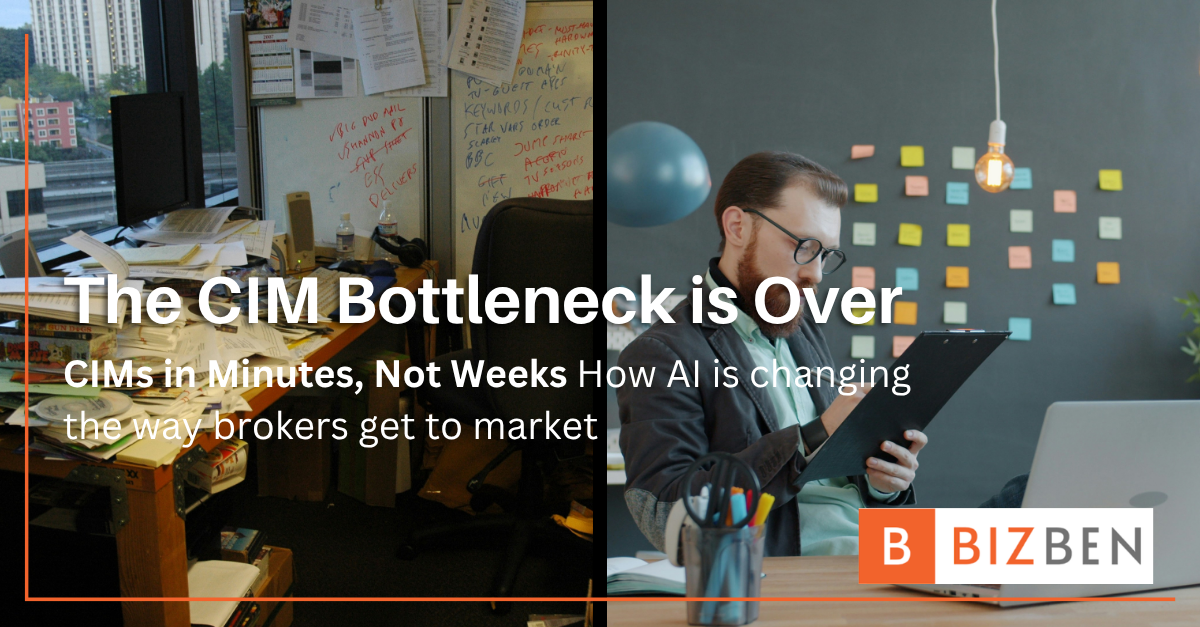
How AI Is Changing the Way Business Brokers Create CIMS
The Confidential Information Memorandum (CIM) is the document that moves deals forward. Despite this, it often slows things down, as drafting a good CIM takes a long time. Writing a CIM manually can take weeks of work before a single buyer even sees your listing.
This, however, is changing. AI-powered tools are compressing timelines from weeks to days, enabling brokers to compete on speed and quality.
This guide covers what goes into a CIM, why the old way drains time, and how to build better materials faster.
What Is a CIM (Confidential Information Memorandum)?
A Confidential Information Memorandum (CIM) is a key document in a business sale. It’s a detailed profile of the company made to give qualified buyers the information they need to decide whether to move forward.
You can think of a CIM as a résumé of a business. A high-quality CIM is one that covers the company overview, financials, growth opportunities, operations, and key risks. All of these are packaged together in one document in a way that builds buyer confidence and drives offers.
What separates a great CIM from a forgettable one? Three things:
- Clarity. Buyers should understand the business within the first few pages.
- Credibility. Financials need to be clean, consistent, and well-presented.
- Positioning. The narrative should highlight value drivers without overselling.
When done right, a CIM should shorten the sales cycle, reduce the back-and-forth with buyers, and ultimately lead to stronger offers. When done poorly, it can slow the deal cycle and potentially even kill it.
How Long Does It Take to Write a CIM?
The CIM writing process is incredibly tedious and takes longer than brokers want to admit.
A typical CIM takes anywhere from 10 to 40+ hours to produce. For complex businesses or deals with messy financials, it can stretch into weeks. That’s not an exaggeration — it’s the reality for brokers juggling a high volume of listings.
This is where that time is actually spent:
- Data gathering (3–10 hours): Collecting financials, lease agreements, employee info, vendor contracts, and operational details from sellers who are often slow to respond.
- Financial analysis (3–8 hours): Normalizing earnings, calculating SDE or EBITDA, building projections, and ensuring the numbers tell a coherent story.
- Writing and positioning (4–12 hours): Crafting the narrative — company history, competitive advantages, growth opportunities — in a persuasive way without being misleading.
- Formatting and revisions (2–10 hours): Designing the layout, inserting charts or tables, and revising drafts based on seller feedback. Then revising again.
Multiply that across five, ten, and even more active listings, and the CIM creation becomes a serious bottleneck.
The Traditional CIM Process (Pain Points)
The way most brokers build CIMs today hasn’t changed much. It’s manual, tedious, and unnecessarily slow.
Manual and fragmented workflows. A Business’s data lives in spreadsheets, emails, shared drives, and in the seller’s head. Pulling all of this together into one document means pulling data from tons of different sources.
Time-consuming and repetitive. Every new listing means starting from scratch — or reworking a previous CIM line by line, hoping you don’t miss something.
Inconsistent quality. Without standardized processes or systems, the quality of your CIMs depends on who wrote it and how much time they had. Buyers notice the difference.
Opportunity cost. The hours spent writing and formatting are hours not spent prospecting, negotiating, or closing. For most brokers, CIM creation is necessary but low-leverage work.
How AI Is Transforming CIM Creation
AI isn’t replacing brokers. It’s replacing the busywork and automating the repetitive tasks in their workflows that used to slow them down.
Here’s what modern AI tools bring to the CIM process:
- AI enables automated writing and structuring by generating a complete, high-quality CIM draft in minutes. Using Retrieval-Augmented Generation (RAG), the system pulls directly from listing data to create detailed narratives, financial summaries, and market positioning—significantly reducing the time required compared to manual processes.
- AI also allows a huge reduction in time. Writing a CIM used to take days to week. Now it takes minutes. That’s not a marginal improvement; it’s an order-of-magnitude shift in how fast brokers can operate.
- CIM consistency is also improved. Every CIM follows the same professional structure and formatting standards, regardless of which broker on your team created it.
- By automating this workflow, scalability is much more possible. When CIM creation no longer bottlenecks your pipeline, you can take on more listings and close more deals without needing more employees.
The brokers adopting AI early aren’t just saving time. They’re gaining a competitive edge in how quickly and professionally they bring deals to market.
Why BizBen’s AI CIM Helps Brokers Save Time
Not all tools in the market are built with business brokers in mind. Most general-purpose writing tools only produce text, but they don’t understand deal structure, buyer psychology, or the specific format that M&A professionals expect.
BizBen’s AI CIM generator is different — it was built specifically for the brokerage workflow.
Designed for brokers, not generalists. BizBen understands the language of business sales: SDE, asking multiples, lease terms, owner involvement. The output reads like it was written by someone who’s actually closed a deal.
Integrated into the listing workflow. There’s no exporting, uploading, or switching between platforms. Your listing data flows directly into the CIM generator, creating a seamless path from listing to CIM to buyer outreach.
Faster and easier than standalone tools. Because it’s embedded in the platform you already use, there’s no learning curve and no extra subscriptions. It just works — within the workflow you’re already running.
The result? Increased deal velocity. A shorter path from signed engagement to buyer interest. And more of your time spent on the high-value activities that actually grow your business — like building relationships, negotiating terms, and closing transactions.
About the Author: Elijah Gjovig

Related Posts













you might also like


How To Sell A Business
By Peter Siegel, MBA

How To Sell A Business,Uncategorized
By Chris Chi

How To Sell A Business
By Peter Siegel, MBA


How To Sell A Business
By Peter Siegel, MBA


How To Sell A Business
By Christina Lazuric, CBI, CBB